
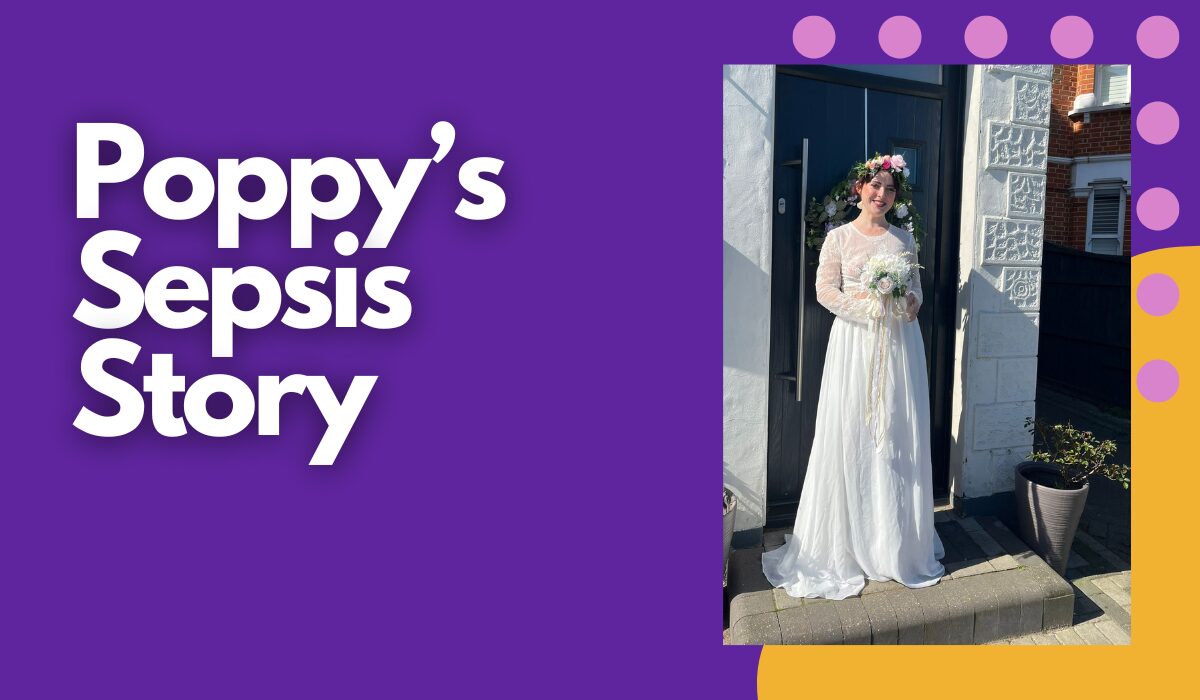
‘Surviving sepsis showed me the beauty in living. I live every day now with gratitude.’
My name is Poppy Gibson and I am a 35 year old mum of three from Essex.
I am a lecturer in education and have been lecturing for nine years having previously been a primary school teacher and leader in London. I love the outdoors and my hobbies centre around my animals and taking time exploring woods, beaches and historic places around Essex with my family.
I was diagnosed with maternal sepsis in October 2014.
I had started feeling unwell at 34 weeks pregnant. It was my second pregnancy so I already knew how my body felt to be pregnant, but this time something felt wrong. On top of the usual fatigue and aches and pains, I had a pain down my left side, a bit like a stitch after you have been running, that just wouldn’t go away. It was accompanied by shallow breathing, and a general feeling of being unwell, like the onset of mild flu. I think being pregnant is part of the reason I put up with the pain for as long as I did, as I suspected it was just my body coping with carrying a large baby as well as the extra fluid (polyhydramnios) which I also had at the time. I didn’t want to be seen to be complaining or making a fuss for no reason. But when I went for my routine check up, the health assessor said that the shallow breathing and left side pain wasn’t normal, and she advised me to go to A&E just to get it checked out.
I went home and told my husband Richard and he agreed we should go to the hospital to be on the safe side.
I felt like a fraud. I was comforted that the medics in A&E took me seriously though and ordered an x ray. When this came back it showed a shadow on the bottom of my left lung. They said that it might either be a compressed lung caused by the pregnancy, or that it could perhaps be pneumonia. Because I said I was feeling unwell, they erred on the side of caution and the lung consultant advised that I needed to begin treatment for pneumonia. I went sent home with a prescription for pneumonia medication, hopeful that I would finally start feeling better.
Instead, I kept deteriorating. When they told me 2 weeks later, at 36 weeks, that I would need to be induced for ICP (Intrahepatic Cholestasis in Pregnancy), I have never felt so relieved. I wanted my baby delivered safely so that I could begin healing.
It was only much later – 9 days post partum, at home in bed, struggling to move even to breastfeed and the pain down my left side ever present – that I suddenly began shivering. My husband said my lips turned blue. He called 111 straight away and they advised him to take me straight to A&E.
One symptom I now know about in sepsis is not passing urine. The medics asked me for a urine sample while we waited to be seen and I couldn’t give one. I asked my husband to buy me a bottle of water from the vending machine and even after drinking it I still couldn’t go.
An MRI was ordered and identified that the shadow at the bottom of my lung spotted all those weeks ago was, in fact, due to a kidney abscess on my left side that had remained undiagnosed for so long that it had turned septic.
I was finally diagnosed with sepsis and admitted urgently to Intensive Care at Princess Alexandra Hospital Harlow, Essex. I was in Intensive care for 9 days
When they told me I had sepsis, I actually felt incredibly ignorant for not even having heard the word before. I knew of the outdated term ‘septicaemia’, or blood poisoning, but thought that was a dangerous infection caught from perhaps an extreme accident, not something I could have developed as a healthy person in my 20s.
The one memory that stands out is when the doctor told me and my husband to make peace and prepare – that my diagnosis had come very late and I was very, very ill. I remember seeing my husband cry, which he never does. I remember thinking I wouldn’t see my two boys again and my heart broke in that moment for all that would never be.
Amazingly after a drain on the abscess, two blood transfusions, and extreme antibiotics in ICU, recovery began.
Finally, on the 9th day I began to feel slightly better. I could sit up. And I was finally allowed to see my baby again – my husband brought him to the hospital. I hadn’t seen him for 9 days and my body had pretty much shut down, unable to feed him.
What then proved to be the biggest help during my treatment and recovery was learning more about sepsis, and connecting with other people whose lives had also been affected. Speaking to other sepsis survivors helped me feel seen. It validated my whole range of emotions: grateful to be alive, but grieving for all that I had lost.
When I was diagnosed with sepsis, I thought I was going to die. But being diagnosed with sepsis changed my whole perspective on life. It made me see we are just mortal; I had never thought about that before. Surviving sepsis showed me the beauty in living. I live every day now with gratitude.
I found Sepsis Research FEAT earlier this year and am so grateful for the stories the charity shares and the information it provides – especially as their website contains information about the medical research it funds as well as personal stories of sepsis.
I am sharing my story with Sepsis Research FEAT now because I wish that someone had recognised sooner that I had sepsis. I didn’t even know what it was at the time but spotting it earlier could have led to a quicker diagnosis, quicker treatment, and a better birth and bonding experience with my baby.
Instead, the first weeks of his life meant I wasn’t there for him. If, by reading my story another pregnant woman or new mum, or someone close to her, is able to recognise sepsis in themselves or others then that makes it all worth it.
You know your body best; if something doesn’t feel right, please keep pushing for further investigation. And if in doubt, don’t be afraid to ask ‘could it be sepsis?’
Charity Comment
Poppy’s story is a powerful call to other pregnant women and new mums to be aware – made in the hope of preventing others from going through what she did herself.
Her clinical experience of her second pregnancy was complicated by ICP, a diagnosis of pneumonia and the ultimate identification of a kidney abscess. The systemic nature of sepsis – when inflammation spreads rapidly throughout the body – makes identifying the origin of an infection in order to treat it at source difficult for even the best trained clinicians.
Most pregnant women are concerned, quite rightly, first and foremost for the wellbeing of their unborn child. Poppy admits that – not unlike many other expectant mums – she put up with the pain because she was pregnant. She was probably unaware of the fact that she was immunosuppressed as a result of her condition. Women in a second or later pregnancy may be even more likely ‘just to get on with it’ with another child or children to look after.
This charity’s maternal sepsis campaign in May 2026 will be the second time that the charity has focussed on the risks of sepsis to new and expectant mums, in the hope of improving outcomes for women at such a crucial point in their own lives and those of their families. Sepsis Research FEAT is very grateful indeed to Poppy for so bravely sharing her story in support of that campaign.


